Last Updated: November 7, 2026
Quick Summary
A salt chlorinated pool is still a chlorine pool: a salt cell converts dissolved salt into chlorine on site, so you stop hauling jugs and tablets while the water stays sanitized by chlorine. The trade-off is maintenance style, not maintenance-free operation, since you clean a cell and watch salt levels instead of buying and adding chlorine.
- Salt systems produce a steadier, lower chlorine residual than manual dosing.
- Keep pH in the 7.2-7.8 range and total alkalinity around 80-120 ppm.
- Bagged pool salt costs roughly $8-$15 per 40-lb bag at typical retail.
- Most residential salt cells last roughly 3-7 years depending on size and run hours.
- Use 316-grade stainless for rails and ladders to limit corrosion.
Table of Contents
- Saltwater Pool vs Chlorine Pool: What’s the Real Difference
- How a Salt Chlorine Generator Works
- Saltwater Pool Maintenance: Chemistry Targets and Troubleshooting
- Dangers of Saltwater Pools: Corrosion, Scale, and Equipment Compatibility
- Climate, Pool Use, and Sizing Considerations
- What Independent Evidence Says About Comfort and Health Claims
- Planning a Salt Chlorinated Pool with Sanchez Pools Inc
- Frequently Asked Questions
Saltwater Pool vs Chlorine Pool: What’s the Real Difference
A salt chlorinated pool is still a chlorine pool. That single fact clears up most of the confusion buyers bring to us at Sanchez Pools Inc. The salt cell converts dissolved salt into chlorine on site, so you stop hauling jugs and tablets, but the water is still sanitized by chlorine.
What changes is how the chlorine arrives and how the water feels. Salt systems produce a steadier, lower chlorine residual instead of the peaks and dips that come with manual dosing.
The trade-off is maintenance style, not maintenance-free operation. A salt chlorinated pool asks you to clean a cell and watch salt levels; a traditional pool asks you to buy, store, and add chlorine. Neither runs itself.
Water Feel, Skin, and Eye Comfort
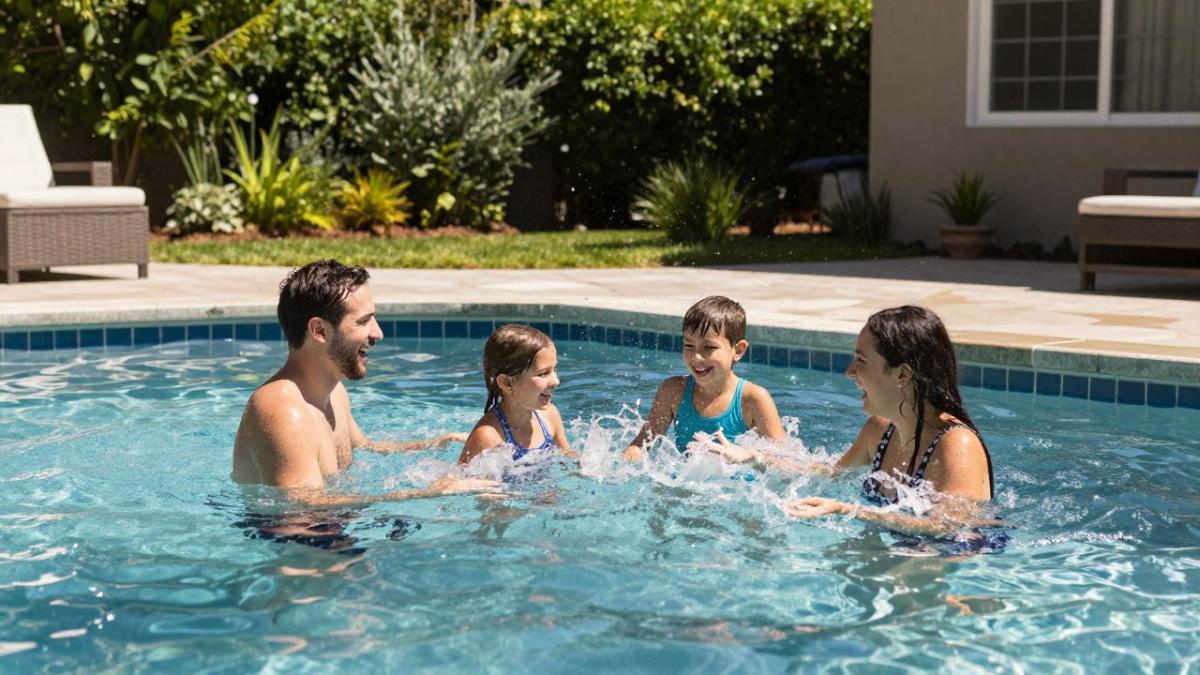
Comfort is the reason most homeowners ask about salt in the first place. Because the chlorine level stays lower and more consistent, irritation complaints tend to drop. That said, a salt chlorinated pool still needs correct pH and alkalinity; water that stings eyes usually has a chemistry problem, not a salt problem. The mechanism is straightforward: at low pH, chlorine converts to a form that off-gasses and irritates mucous membranes, and at high pH it loses killing power, so the comfort story is really a pH story. Keep pH in the 7.2-7.8 range, hold total alkalinity around 80-120 ppm, and the “soft water” reputation holds up. Let pH drift above 8.0 and even a low-residual salt pool will sting eyes and smell sharp.
Total Cost of Ownership Side by Side
Broad “salt saves money” claims are where most articles stop, and they are where most buyers get misled. The honest answer is that a salt system front-loads equipment cost and back-loads a predictable replacement cost, while a traditional pool spreads chemical cost across every week you own it. Which is cheaper depends on pool size, bather load, electricity rates, and how long you keep the pool.
| Cost line | Salt chlorinated pool | Traditional chlorine pool |
|---|---|---|
| Upfront equipment | Salt cell, controller, and flow sensor add a meaningful premium over a basic chlorine setup, commonly several hundred to over a thousand dollars depending on cell size and automation | Lower upfront; a feeder or floater is inexpensive |
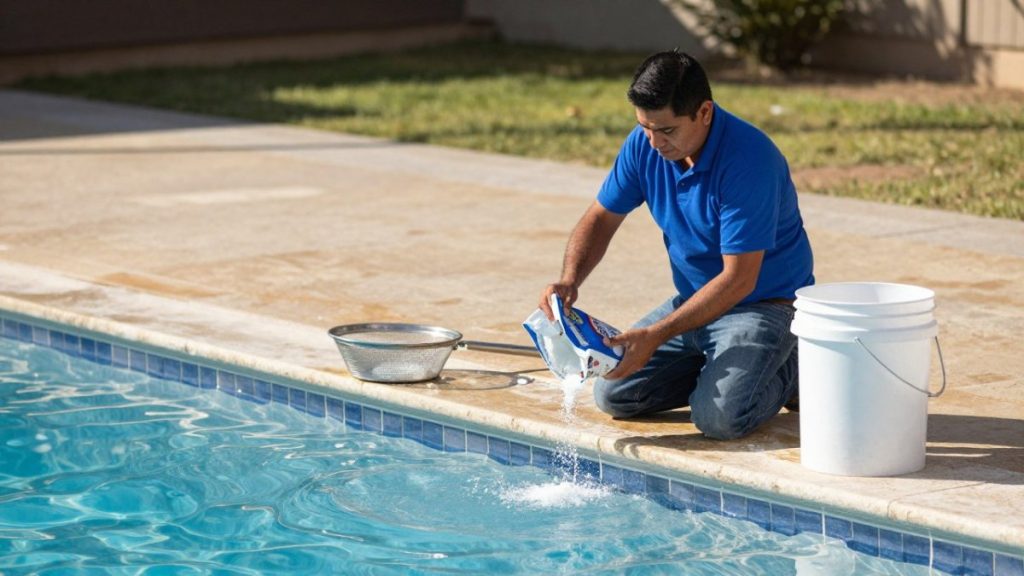
| Ongoing sanitizer | Bagged pool salt (roughly $8-$15 per 40-lb bag at typical retail), plus occasional muriatic acid for pH control | Chlorine tablets or liquid chlorine, purchased weekly through the season |
| Electricity | The cell draws power while the pump runs; production is tied to pump run time | No added electrical draw beyond the pump |
| Replacement cycle | Salt cells are consumable; most residential cells last roughly 3-7 years depending on size, run hours, and water chemistry | Feeders and floaters are cheap and replaceable |
| Routine labor | Cell cleaning, salt checks, acid dosing | Dosing, storage, and hauling |
| Water feel | Softer, steadier residual | Can spike after dosing |
Cell sizing affects how long the cell lasts, so it is worth discussing with your builder before you commit to a system. If you want the construction side of the budget, see our breakdown of what building a pool actually costs.
How a Salt Chlorine Generator Works
A salt chlorine generator passes dissolved salt water through an electrolysis cell. An electric current splits sodium chloride, and the cell produces free chlorine that sanitizes the pool, then reverts to salt and repeats the cycle. You are not “adding chlorine” so much as giving the system the raw material to make it.
The components are simple: a salt cell, a controller, and a flow sensor. Salt level typically sits in a range the manufacturer specifies, measured in parts per million, and the controller tells you when production drops. If you want to see the hardware itself before deciding, our pool equipment page shows what a generator looks like and what a system includes.
Salt Cell Sizing and Lifespan
An undersized cell runs at full output constantly, which shortens its life and leaves you short on chlorine during heavy-use weeks. A cell run at moderate output lasts longer and holds chlorine levels more consistently.
Watch out: skipping cell cleaning lets scale buildup choke production until the cell reads as failed when it is only fouled. Inspect and clean it on the schedule your manufacturer recommends.
Saltwater Pool Maintenance: Chemistry Targets and Troubleshooting
Saltwater pool maintenance is mostly the same routine as any pool: test, balance, and circulate. The difference is that you are managing salt and cell output alongside the usual readings. Test free chlorine and pH weekly, check salt level monthly, and clean the cell when the controller signals it.
Common fixes follow a pattern:
- Low chlorine with normal salt: check cell output setting and inspect for scale.
- High pH drift: salt systems tend to push pH upward; add acid as needed.
- Cloudy water: usually circulation or filtration, not salt level.
- Salt too high: dilute by partial drain and refill.
If chemistry keeps fighting you, professional pool cleaning and maintenance takes the guesswork out of the weekly routine.
pH, Alkalinity, and Calcium Hardness
Keep pH in the standard range, hold alkalinity steady to prevent pH bounce, and maintain calcium hardness so water does not pull minerals from your surface. Cyanuric acid protects chlorine from sunlight; too much of it locks chlorine up and causes persistent problems.
Dangers of Saltwater Pools: Corrosion, Scale, and Equipment Compatibility
The real dangers of saltwater pools are not health risks; they are material risks. Salt raises the water’s total dissolved solids and conductivity, and splash-out leaves salt residue on decking, rails, and equipment pads. Over years, that combination attacks the wrong metals and the wrong stone. Understanding which materials are at risk, and which are fine, is the difference between a salt pool that ages gracefully and one that eats its own hardware.
Metals. The vulnerable items are the ones you touch: handrails, ladders, light bezels, and any fitting made from low-grade stainless or plain galvanized steel. Salt and moisture drive galvanic and crevice corrosion, and the first sign is usually pitting or a chalky white bloom at a fitting. The fix is specification, not luck: use 316-grade stainless for rails and ladders, bond and ground the pool per code, and keep sacrificial anodes on any salt-water heat exchanger.
Stone and decking. Natural stone is porous, and salt crystals grow in the pores as water evaporates, flaking the surface. Soft stones, sandstone, limestone, and some flagstones, are the most vulnerable; dense stone like granite and certain travertines hold up better. Seal stone and concrete decking on a schedule, rinse splash zones periodically, and avoid letting salt-laden water pool against the deck edge. Coping and tile are generally fine if they are rated for pool use and properly grouted.
Equipment. Not every heater, pump, or automation system pairs cleanly with a salt cell. Heat exchangers are the classic failure point: a standard copper heat exchanger in a gas heater can be attacked by aggressive water, and manufacturers often require a cupronickel or polymer exchanger for salt pools. Check the warranty language before you buy, several manufacturers void coverage if a salt system is installed without the specified exchanger.
Scale. High pH and hard water combine to coat the cell and heater with calcium, cutting efficiency and eventually choking chlorine production. Keep pH in range, watch calcium hardness (roughly 200-400 ppm for most plaster pools), and inspect the cell for scale on the manufacturer’s schedule. A scaled cell reads as failed when it is only fouled.
Prevention checklist.
- Specify 316 stainless for rails, ladders, and light fixtures.
- Confirm the heater’s exchanger is rated for salt water and that the warranty allows it.
- Seal natural stone and porous decking, and re-seal on schedule.
- Bond and ground all metal components per local code.
- Rinse splash zones and equipment pads periodically.
- Keep pH, alkalinity, and calcium hardness in target range to limit scale and corrosion.
If corrosion or equipment failure is already a concern, our pool repair and installation team handles equipment replacement and compatibility checks.
Climate, Pool Use, and Sizing Considerations
Hot, sunny climates push chlorine demand up, and a salt cell has to keep pace. Heavy bather loads do the same.
Sizing also depends on surface area, shade, and how long you run the pump each day. More run time means more chlorine production, but it also means more electricity. Balance the two before you commit to a cell.
What Independent Evidence Says About Comfort and Health Claims
Claims about saltwater comfort are largely anecdotal, and honest advice says so. Many swimmers report softer water and less irritation, and the lower steady chlorine residual explains part of that. What the evidence does not support is the idea that saltwater pools are chemical-free or medically better for asthma or skin conditions.
The CDC’s healthy swimming guidance is clear that all pools need proper disinfection and monitoring, salt or not. For water chemistry standards, the APSP pool and spa resources cover the ranges professionals work from. Treat comfort claims as a preference, not a health promise.
Planning a Salt Chlorinated Pool with Sanchez Pools Inc
Choosing a salt chlorinated pool involves decisions about equipment sizing, surface and equipment compatibility, and maintenance responsibility.
Sanchez Pools Inc has built custom pools as a family-owned company since 1987, We handle new construction, remodeling, equipment replacement, and troubleshooting, so the same team that designs your pool can service it later.
If you are ready to plan, contact us to start the conversation about your backyard.
The challenge is not picking salt over chlorine; it is matching the system to your pool, your climate, and your maintenance habits. Get that wrong and even a good cell disappoints. Sanchez Pools Inc designs and builds custom pools with equipment specified for the site, backed by decades of construction and service experience and a commitment to safety. Get started with Sanchez Pools Inc and build a pool that performs the way you expect.
Frequently Asked Questions
Does a saltwater pool still use chlorine?
Yes. A salt chlorinated pool is a chlorine pool. The salt cell turns dissolved sodium chloride into free chlorine through electrolysis, so the water is sanitized by chlorine either way. The difference is delivery: you add salt once or twice a year instead of buying chlorine tablets or liquid chlorine weekly. You still test free chlorine and keep it in the 1 to 3 ppm range, and you still shock when chlorine demand spikes after heavy use or rain.
What is the downside of a saltwater pool?
The main downsides are upfront cost for the salt chlorine generator, ongoing salt cell replacement, and higher pH that needs acid adjustments. Salt and moisture can corrode certain metals and damage soft natural stone if the pool is not designed for it. The salt cell also needs cleaning when scale builds up. None of these are dealbreakers, but they are real costs and maintenance tasks to plan for before you build or convert.
How do you maintain a salt chlorinated pool?
Test salt level, free chlorine, pH, alkalinity, calcium hardness, and cyanuric acid weekly. Keep salt in the range your generator requires, usually 2,700 to 3,400 ppm. Clean the salt cell when scale appears, check the flow switch, and inspect the cell for wear. Brush and vacuum on a normal schedule, and shock when chlorine demand rises. Most of the work is water testing and pH control, not adding chlorine by hand.
How much does it cost to convert a chlorine pool to salt?
Conversion cost depends on pool size, the salt chlorine generator you choose, and whether your pump, filter, and plumbing are compatible. Pricing depends on quantity, dates, and delivery, so ask Sanchez Pools Inc for a current quote rather than relying on a generic figure.