San Antonio Natatorium – Cool Texas Pools

san antonio natatorium wide angle

San Antonio Natatorium – Cool Texas Pools

The San Antonio Natatorium is an indoor public swimming pools in San Antonio located on popular Cesar Chavez street. It is temperature-controlled, allowing swimmers to practice their water skills in the heart of San Antonio year-round. Admission is affordable, and the city offers passes for seasonal swimming at competitive rates. The pool remains open most days of the week and has a large capacity. San Antonio Pool Builders spent months and months working on this pool and is one of the largest indoor public swimming pools in San Antonio TX.

(Photo Source: San Antonio Parks & Recreation)

Where did the San Antonio Natatorium come from?

The history of the San Antonio Natatorium is short but rich. It was built in June 1981 to allow inner-city children the opportunity to practice and gain the skill necessary to be competitive in regional and intramural swimming leagues.The pool replaced the disused Sidney Lanier High School track after the track no longer received maintenance. Henry Cisneros, a San Antonio City Council member who was especially active in community and education, worked with the San Antonio Independent School District, or SAISD, to bring the project to fruition.

San Antonio and development in the 1980s

In the early 1980s, San Antonio was just beginning to evolve into a large city. There weren’t many major city projects in the works, and the Rivercenter Mall stood as a testament to the growth that San Antonio had experienced until the turn of the decade. Outward expansion and development stagnated growth in the middle of the city. The city council decided that it needed to look inward to improve the conditions of the inner-city.

The Natatorium project was a beacon of hope. At $3.2 million, the pool was an investment in city beautification, land value improvement, and the future of education for those struggling to make their way in the city center. The investment paid off – the Natatorium has hosted international swimming competitions, high-school level swim meets and official competitions by age group since it was established in 1981.

What features does the San Antonio Natatorium have?

While the original purpose of the Natatorium was simply to provide inner-city kids with an affordable swimming practice facility, the scope of the pool proved convenient for hosting serious competitions. In the late 90’s, major pool repairs closed the pool for several weeks.

The San Antonio Natatorium boasts the following:

  • Length: 50 meters
  • Width: 25 yards
  • Lanes: 8
  • Temperature: 82 degrees Fahrenheit

It also offers these activities

  • Lap Swimming
  • Water Aerobics
  • Swimming School
  • Recreational Open Swim Time
  • Private Swimming Lessons
  • SCUBA Classes

Swimming classes, SCUBA instruction, and water aerobics activities are all coached by licensed professionals who have undergone a rigorous recruitment process. Lifeguards, staff, and coaches must meet rigid standards to qualify for their positions, take a pre-test before being screened, and train regularly after recruitment.

There are also showers and locker rooms for guests who pay admission. Pool activity times are scheduled and clearly marked for the convenience of pool guests.

Why is the Natatorium the Largest Public Swimming Pools In San Antonio TX?

The San Antonio Natatorium known as the largest public swimming pools in San Antonio TX has not only proven to be a valuable tool for improving quality of life and education in the inner San Antonio area. It has also helped lots of successful swimmers reach peak condition for high-level competition.

The Natatorium has produced multiple state qualifiers for UIL swimming and diving competitions. The University Interscholastic League, or UIL, is the highest level of academic athletic administration, and standards for competing in a UIL competition are notoriously stringent. Of the UIL participants, several regional champions have used the pool for practice.

On a larger scale, the 2000 Australian Olympic swimming team trained at the San Antonio Natatorium before competition. Even some Olympic gold medalists have trained at the pool, including Misty Hyman, Karen Perkins, Bruce Hayes, and Grant Hackett.

A single admission is only $2 for an entire day, so next time you’re in San Antonio, relive a bit of history and touch the waters that UIL and Olympic greats have touched on the road to victory.
Cool Texas Pools – San Pedro Springs Park Pool

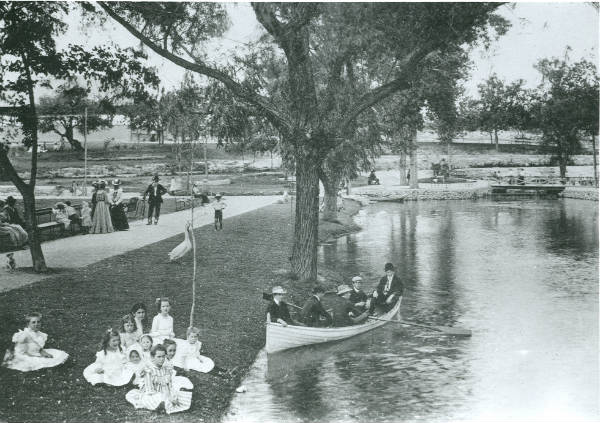
san pedro swimming pool in the early days.

COOL TEXAS SPRINGS PARK POOL – SAN PEDRO SWIMMING POOL

San Antonio’s San Pedro Springs Park is one of America’s oldest parks. It is younger than only one other park: Boston Common, established in 1630. San Pedro Springs was a hunting and gathering site 12,000 years ago. Spanish explorers decided to use the area for long-term campsites in the late 1600s.

Today, the San Pedro Springs Park includes one of San Antonio’s most popular San Pedro swimming pool, as well as a wealth of recreational equipment for public use. Some of the attractions include:

  • Sports areas for softball and tennis
  • Playgrounds
  • Skatepark
  • Library
  • Theater
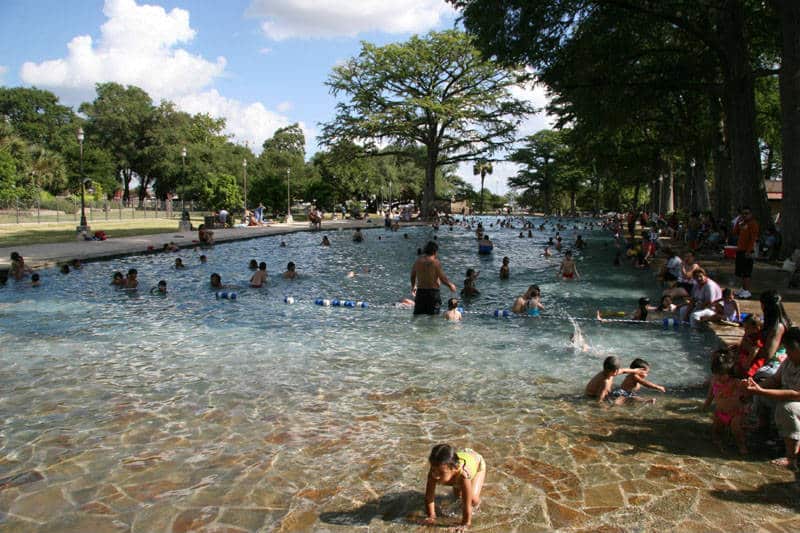
san pedro pool modern swimmers
Source: edwardsaquifer.net

SAN PEDRO SPRINGS PARK HISTORY

The springs provided Native Americans with water and resources. They used the rocks to build weapons and tools for hunting and living. Archaeologists believe that the Payaya Indians were using the area as far back as 12,000 years ago. They called their village next to the Springs Yanaguana.

It didn’t receive its modern name until two clergymen named Antonio de San Buenaventura de Olivares and Isidro Felix de Espinosa returned to the area following a military expedition by Damien Massanet.

THE FOUNDING OF SAN ANTONIO

Martín de Alarcón found the Springs to be the perfect spot to build a mission. He established San Antonio de Valero and the Presidio San Antonio de Bexar on-site in 1718.

A small community grew around the area thanks to the abundance of water and natural resources. As they began to stretch south, the Spanish settlers saw the need to expand their water carrying capabilities. They constructed a water course called an acequia for easier access to the plentiful water.

The area was easy to irrigate and offered beautiful, fertile land. Settlement of the area encouraged natural growth. As nature flourished, the area became perfect for recreation. An influx of visitors caused even more prolific growth. The city of San Antonio began to expand beyond expectations.

THE EXPANSION OF THE PARK

The area around the spring became a reserve In 1852. The San Antonio City Council leased the area to John Jacob Duerler for the expansion of its recreational facilities. He built plazas for food and stage areas for entertainment.

The Civil War saw a shortage of suitable places for army activity. The park was transformed to accommodate Army experiments and hold prisoners of war. The natural beauty and recreational facilities fell into disuse.
The city council recognized the importance of the park. They banned military and industrial activity in the area in 1863. The lessee, Duerler, made an agreement with the city to return the park to its former splendor as a reserve. He pushed the limits of the park’s recreational boundaries. Additions include swimming pools, ponds, flower gardens, ballrooms, zoos, and sports fields. After his death, a series of lessees made improvements to the area before the spring’s flow started to die in the 1890s.

San Pedro Pool Vintage

DISREPAIR AND RENOVATION

Depression compromised the city’s coffers as the 1890s continued. Maintenance for the park fell by the wayside. San Antonio tourism dropped and the city became concerned. Bryan Callaghan, the freshly reelected mayor, had San Pedro Springs Park cleaned, repaired, and renovated. The city paid for major additions of flora and fauna.

At the turn of the century, the city of San Antonio began to wrap around the park. City leaders enjoyed the draw of the park and its effect on land values. Improvements continued throughout the 1900s. Ray Lambert, Parks Commissioner in the early 1900s, overhauled San Pedro Springs Park to match its original design and facilities. He included improvements to the major San Pedro swimming pool as a centerpiece.

SAN PEDRO SWIMMING POOL PARK TODAY

A final renovation went underway from 1998 to 2000. It now resembles the park as it stood at its inception. The San Pedro swimming pool is now a popular gathering spot and an ideal way to beat the Texas heat. Its rich history is a big draw for tourists, and the park offers its facilities for plays, weddings, graduations, and other major events.

Deep Eddy Pool – Cool Texas Pools

Deep Eddy Early 1900s


Deep Eddy Pool – Cool Texas Pools

The average summer temperature in Texas is about 97℉. That’s hot. But on some days the temperature can reach into the 100s. The record high for a San Antonio, Texas September is 111℉. That’s even hotter.

Texans know how bad the heat can get. If you grew up in Texas, you probably also know how to beat the heat pretty well. Before the days of air conditioning, Texas residents had to be creative when keeping cool. Thankfully, Mother Nature is on our side and offers plenty of great spots to cool off during the scorching Texas summer.

Texas Pools to the Rescue

Swimming pools are becoming a fixture for suburban homeowners and apartment dwellers alike. Most modern apartments have a family pool free for resident use. Homeowners are installing their own personal pools on their properties as it becomes more affordable.

But it wasn’t always that way. Before pools became so accessible, overheating Texans had to search out nature’s bounty of natural water. Texas may be dry, but it has no shortage of natural swimming pools that are among some of the best places to cool off in the world.

Deep Eddy Brings the Cold

Deep Eddy Pool provides recreational swimming for families that live in Austin. You’ll find it nestled off of the bank of the Colorado River and the Missouri Pacific Railway in Austin. It’s modern appearance looks almost nothing like the way it has looked historically. It has seen many evolutions throughout its life, but it actually began as a simple watering hole. The bank of the Colorado River formed an eddy that provides a safe haven for swimmers who don’t want to get caught up in the river current.
https://sanchezpoolsinc.com/wp-content/uploads/2015/09/What-Is-Eddy.jpg

Photo from Wikimedia Commons

What is an Eddy Anyway?

Sailors and fishermen may know it well, but eddy isn’t a layman’s term. An eddy is a pool of fresh natural water formed when flowing water meets an immovable obstacle. The water has to begin flowing in another direction when it meets the obstacle because of pressure from the current. Once the water is pushed by the current, it no longer flows in the same direction. The forward flow of the current meets with the reverse flow past the obstacle. It pushes the water in a different direction, creating a swirl.

The space in front of the object fills with water that doesn’t flow with the current. The water is also protected by the swirling water on either side of the obstacle. The swirls provide the area in front of the obstacle with constant fresh water. The still, circulating water is a perfect area for recreational swimming.

That’s Where Deep Eddy Pool Began

The history of Deep Eddy Pool goes further back than the beginning of civilization in Texas. Long ago, the bank at the Colorado River and Missouri Pacific junction housed an unusually large boulder. It acted as an obstacle that created an eddy just off of the land where people could swim. It didn’t take long for potential landowners to notice that the spot was popular and would make a great investment.

An investor with a vision came in and made serious changes in 1915. A.J. Eilers wanted to create an all-inclusive resort in which visitors could spend large amounts of time (and money). The Deep Eddy Bathing Beach would include all the amenities of a park alongside a man-made pool with natural water from the Colorado River. Eilers built cabins for overnight stays as well as a fully functional bathhouse. He also set up campsites where beachgoers could sleep in the wilderness. He included food and drink stands for his more affluent visitors.

More importantly, he transformed the natural eddy created by the boulder into a concrete swimming pool. To draw even more visitors, Eilers built attractions alongside the pool. Among the more popular ones was Lorena’s Diving Horse. The diving horse attraction had been a trendy show that started in the 1880s in which a horse and rider dive together from a high dive. Deep Eddy’s diving horse dove from a 50-foot-tall diving board into the Deep Eddy pool. Eilers even included a Ferris wheel at his park.

https://sanchezpoolsinc.com/wp-content/uploads/2015/09/Deep-Eddy-Panorama-e1443631665269.jpg”

The Pool Sees Big Change

A huge flood in 1935 destroyed most of the park’s attractions and completely filled the pool with mud and remains. The City of Austin had purchased the pool and park just before the flood destroyed it and before the city broke ground on any improvements. Because of the massive cost of rebuilding the park in its entirety, the city opted to restore only the pool and bathhouse. They reopened the park as is in 1936.

Now open to the public, the park became a memorial to A.J. Eilers. The bathhouse fell out of use and turned into an exhibition center. The non-profit organization Friends of Deep Eddy, interested in conserving the history of Deep Eddy Pool, raised funds and restored the bathhouse to its original glory in 2007. The pool still uses natural water from a well and now includes an area for lap swimming and a shallow wading section for children. It is also used to train lifeguards and aquatics researchers as well as host numerous public events. A hike and bike trail leads from the pool to other Austin parks, and a dock connects boaters to Town Lake. A barbecue pit allows swimmers to host parties and barbecues for all-day fun.

Appreciating Texas Pools

If you’re outside of San Antonio and looking for a pool, dip your toes into Deep Eddy. Next time you visit, you can look around and see the history of Deep Eddy Pool with your own eyes. When you get to know the lengths that Texans have gone to stay cool in the searing summer air, you can appreciate the splendor of your own pool in the comfort of San Antonio.